


Someone in your house is sick. Maybe it’s a stomach bug tearing through your kids, or your partner is completely flattened by the flu. Either way, your bathroom just became ground zero.
I’ve dealt with this more times than I’d like to admit—four kids will do that to you. And the thing most cleaning guides never bother to mention is that there’s a massive difference between cleaning a bathroom and actually sanitizing it when someone is genuinely ill. One makes it look clean. The other actually keeps everyone else in the house from getting hit next.
Here’s what I’ve figured out, sometimes the hard way, about doing this right.
Understand the Difference: Cleaning vs. Disinfecting
This is where most people go wrong. Fast.
Cleaning removes dirt and debris. Disinfecting kills pathogens. You need both, in that order, every single time—because disinfectants can’t punch through layers of grime or soap scum to do their job properly.
The CDC has been pretty consistent about this since at least 2020: clean first, then disinfect. Skip that first step, and you might spray bleach solution on a toilet seat that still has organic matter on it. You’ve essentially wasted your time. The disinfectant gets neutralized before it ever gets a chance to work.
So think of it as two separate missions happening back-to-back, not one combined task.
What You Actually Need Before You Start
Don’t just grab whatever’s under your sink. Get specific.
You want an EPA-registered disinfectant—look for the EPA registration number on the label. Products like Lysol Disinfecting Spray or Clorox Clean-Up Bleach Cleaner Spray are solid choices because they’re actually tested against norovirus, influenza A, and rhinovirus (the common cold virus). A 2022 review published in the American Journal of Infection Control confirmed that sodium hypochlorite (bleach) at a concentration of 0.1% to 0.5% is effective against most household pathogens within one to two minutes of contact.
You’ll also need: disposable gloves (not the reusable kind you’ll keep touching sick-person germs with), paper towels instead of cloth, a dedicated set of cleaning tools just for this bathroom while someone’s ill, and a surgical or N95 mask if the illness involves vomiting.
Keep everything in a bucket you can carry room to room. Sounds basic. Makes a real difference.
Start With Ventilation and Personal Protection
Open the window. Turn on the exhaust fan. Both, if you can manage it.
Aerosolized particles from vomiting—or even just flushing the toilet—can hang in bathroom air longer than you’d expect. A 2021 study out of the University of Leeds found that toilet plumes can scatter particles up to 1.5 meters above the toilet seat. That’s roughly five feet. Breathing that in while you’re cleaning defeats the whole point.
Gloves go on before you touch anything. Mask goes on before you even open the bathroom door. And don’t touch your face. I know that sounds obvious, but I’ve caught myself adjusting my glasses mid-clean with a gloved hand and had to start the whole glove process over again.
The Right Order for Cleaning Each Surface
Order matters more than speed here.
Start high, work low. Wipe down light switches, door handles (inside and outside), faucet handles, and the towel rail first. These are the high-touch surfaces that most guides bury at the bottom or skip entirely—which is backwards.
Then move to the sink: faucet, basin, surrounding counter. The toilet comes next. Seat, lid, handle, the outside of the tank, and the base where it meets the floor. That base area catches splatter nobody ever thinks about. Then the floor. Then the shower or tub if the sick person’s been using it.
Apply your disinfectant and let it sit for the contact time printed on the bottle. This is called dwell time, and it’s the step everyone skips. Most people spray and immediately wipe. That doesn’t work. Lysol Disinfecting Spray needs anywhere from 30 seconds to 10 minutes depending on the pathogen. Clorox products often require 2 minutes. Read your specific label. This single step is where most DIY disinfection completely falls apart.
How Often to Clean During an Active Illness
Once a day is not enough. Sorry.
When someone is actively sick with something contagious—norovirus, flu, stomach bugs—you should be hitting high-touch surfaces at minimum twice daily. If someone vomited? Clean immediately, then again two hours later.
I know that feels excessive. But norovirus can survive on hard surfaces for days. The NHS documented outbreaks in 2019 where norovirus persisted on bathroom surfaces for up to 12 days in hospital settings where cleaning wasn’t thorough enough. Your home isn’t a hospital, but the biology doesn’t care about that distinction.
Ideally, the sick person gets their own dedicated bathroom. If that’s not possible, give them their own towels (kept completely separate), their own hand soap dispenser, and clean the shared bathroom after every use if you can manage it.
Don’t Forget These Commonly Missed Spots
Here’s the stuff nobody puts on their list.
The toilet flush handle. The toilet paper holder. The underside of the toilet seat (not just the top). The soap dispenser pump. The light switch plate. The door lock or latch. The exhaust fan pull cord if you’ve got one of those older chain-pull styles.
And towels. Hot wash at 60°C (140°F) minimum, immediately—don’t leave them sitting in a hamper in the bathroom where they’re basically a germ hotel. Wash them alone, separate from everything else.
Bath mats too. Especially if someone with a stomach bug has been shuffling back and forth across the same mat all night.
After the Person Recovers: The Full Reset Clean
Don’t stop the moment someone says they feel better.
Do a full deep clean within 24 hours of the person being symptom-free. Everything: grout lines, the inside of the toilet bowl, the u-bend area around the base, cabinet interiors if anything got touched while they were sick.
Throw out any partially used bar soap they were using. Liquid soap dispensers should be emptied, washed with hot water and dish soap, and refilled fresh. Toothbrush holders get sanitized or just replaced.
And ventilate again. Really air the room out—window open for a few hours if possible. Your bathroom has been fighting a battle for days. Let it breathe.
Bottom Line
Here’s something I haven’t seen written anywhere else: the psychological tendency to clean less thoroughly once someone starts feeling better is actually when you’re at the highest risk of spreading the illness. Viral shedding—the period when someone is still contagious—often continues for 48 to 72 hours after symptoms disappear. So the day your kid announces “I feel fine, can I go to school?” is the same day you should be running your most thorough bathroom clean of the entire illness. That’s the window most households miss completely.
Frequently Asked Questions
Can I use regular household bleach instead of a commercial disinfectant?
Yes, but you need to dilute it correctly. The CDC recommends 5 tablespoons (one-third cup) of bleach per gallon of water for most surface disinfection, or 4 teaspoons per quart. And never—I mean never—mix bleach with ammonia or vinegar. It creates toxic fumes. That’s genuinely dangerous, not just a label warning.
How long does norovirus live on bathroom surfaces?
Norovirus is unusually stubborn. On hard non-porous surfaces like porcelain and stainless steel, it can survive anywhere from a few hours to several days without disinfection. That’s exactly why dwell time isn’t optional—it’s the whole point of disinfecting in the first place.
Should I use different products for the toilet vs. the sink?
You can use the same EPA-registered disinfectant on both. But don’t reuse the same paper towels or cloths—grab fresh ones for each surface to avoid cross-contaminating areas. It sounds fussy, but it’s actually one of the most important habits you can build during an illness cleanup.
Is it safe to clean the bathroom while I’m pregnant?
Bleach-based products should be used with real caution during pregnancy. Ventilate heavily, wear gloves, limit your exposure time, and honestly—consider asking someone else to handle the disinfecting if that’s an option. Hydrogen peroxide-based disinfectants are a gentler alternative with solid efficacy against most common illness-causing pathogens.
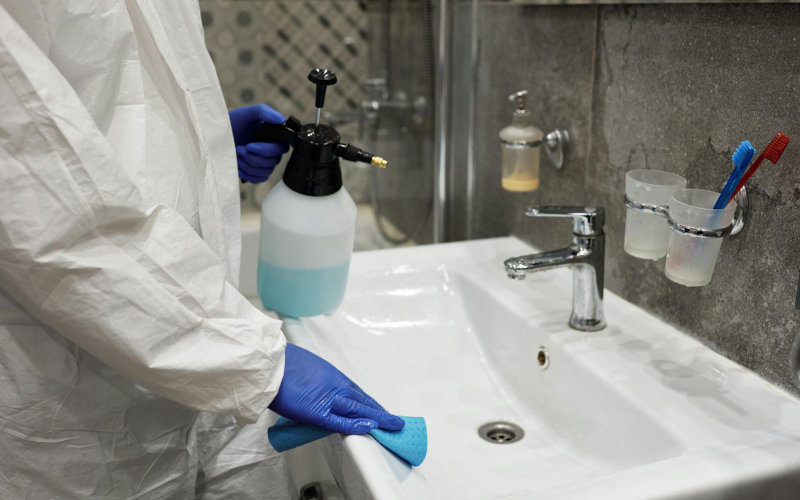
Photo by Matilda Wormwood on Pexels