
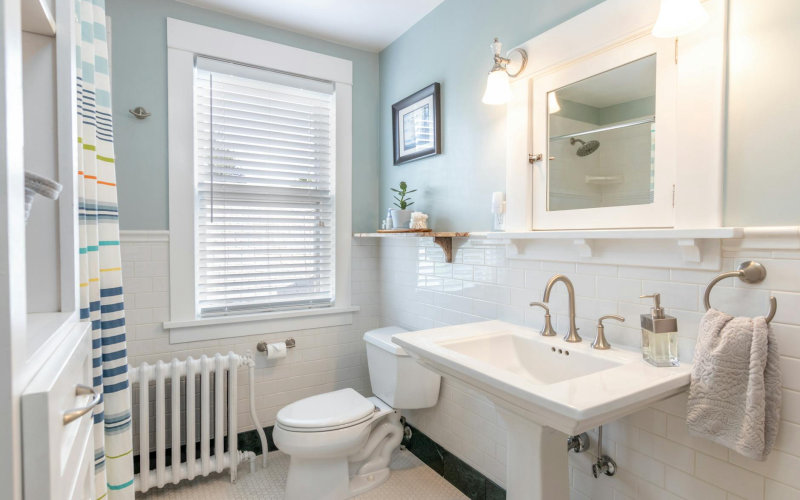


You just scrubbed the whole bathroom. Toilet, sink, floor, grout. Used the good stuff, too — not the dollar store cleaner, the actual name-brand antibacterial spray that costs $7 a bottle. And twenty minutes later you walk back in and it still smells weird. Not “dirty” exactly. Just… off.
I’ve been there so many times it’s embarrassing. For years I assumed I was simply bad at cleaning bathrooms. Turns out I wasn’t cleaning the right things. Most of us aren’t. The smell isn’t coming from where you think it is, and some of the products you’re using might actually be making certain problems worse.
So let’s get into what’s really going on — and what to do about each one.
The P-Trap Is Probably Dried Out
This one stumps people constantly. Under every sink and shower drain there’s a curved pipe called a P-trap. Its whole job is holding a small pocket of water that blocks sewer gases from floating up into your house. But if a drain doesn’t get used much — a guest bathroom, a second sink — that water evaporates. Gone. And suddenly you’ve got a direct line between your nose and the municipal sewer system.
Run the water. Seriously, that’s the entire fix. Thirty seconds in any drain you don’t use regularly, about once a week. Got a floor drain in an older bathroom? Pour a cup of water down it every few weeks. This takes less than a minute and costs nothing.
Your Toilet’s Wax Ring Might Be Failing
Nobody wants to hear this one. But the wax ring that seals your toilet to the floor can crack or shift — especially in older homes, or if the toilet wobbles at all when you sit on it. Even a tiny gap lets sewer gas seep through. The smell is usually sulfur, rotten egg, unmistakable once you know what you’re sniffing for.
Here’s a quick test: sit on the toilet and rock slightly side to side. Any movement? That’s your wax ring telling you it’s finished. A replacement costs about $10 at any hardware store, and if you’re reasonably handy you can swap it yourself in an afternoon. Not a DIY person? A plumber typically charges $150–$250 for the job. Worth every cent versus smelling sewage every time you brush your teeth.
Grout Is Holding Onto Mold You Can’t See
Here’s something most cleaning guides skip entirely: grout is porous. Highly porous. When mold gets inside the grout matrix — not just on the surface — your regular tile cleaner doesn’t reach it. You scrub, it looks clean, but the mold colony is sitting maybe 2–3mm below the surface, quietly producing that musty, damp-basement funk.
The fix isn’t scrubbing harder. It’s chemistry. A paste of baking soda and hydrogen peroxide (roughly 2:1 ratio), left on the grout for 15 minutes before scrubbing, penetrates better than most commercial sprays. For serious mold, diluted bleach — one part bleach to ten parts water — applied with an old toothbrush and left for 10 minutes actually gets into the pores. Rinse thoroughly afterward. And if your grout is more than 5–7 years old, resealing it annually makes a significant difference going forward.
The Toilet Brush Holder Is a Biohazard
I’m not exaggerating. I replaced mine back in 2021 after stumbling across a microbiology post describing what actually grows in that pooled water at the bottom of those plastic containers. Stagnant water, trace fecal matter, bacteria that survived the bowl — it ferments into a smell that drifts around your bathroom constantly. And because it’s slow and low-level, you might not even consciously clock where it’s coming from.
After every use, let the brush drip-dry by resting it under the toilet seat for a few minutes before putting it back. Dump and rinse the holder weekly. Better yet, switch to a ventilated or wall-mounted design that doesn’t trap water at all. Some people swear by disposable brush heads — not the most environmentally friendly call, but genuinely effective.
Your Exhaust Fan Isn’t Actually Working
Test yours right now. Hold a single square of toilet paper up to the vent cover while the fan’s running. Does it stick? It should. If it falls or barely flutters, your fan isn’t moving enough air. Bathroom exhaust fans are rated in CFM (cubic feet per minute), and a 50 sq ft bathroom needs at minimum 50 CFM. Most builder-grade fans installed before 2010 are woefully underpowered.
Poor ventilation means moisture lingers. Moisture means mold. Mold means smell. It really is that simple a chain. Cleaning the vent cover helps somewhat (dust accumulates there and chokes the airflow), but if your fan is genuinely weak, a replacement unit from Broan or Panasonic runs $60–$180 and the difference is immediate. Run it for 20 minutes after every shower — not just while you’re standing in there.
Hidden Urine Splatter Is the Unglamorous Truth
This is the part nobody wants to discuss. But if you have males using your bathroom — any age — urine splatter lands in places that aren’t intuitive. Behind the toilet. Under the rim. On the baseboards. On the wall directly behind the bowl. Even on the outside of the tank. Regular cleaning misses these spots because we clean what looks dirty, not what actually is.
Urine breaks down over time into ammonia and other compounds with a sharp, acrid edge. Even a tiny dried amount, sitting for a week, can make an otherwise clean bathroom smell distinctly not-clean. Get yourself a UV blacklight flashlight (under $20 on Amazon) — it’ll show you exactly where the splatter landed, and the results are usually equal parts horrifying and illuminating. Clean those spots with an enzymatic cleaner, not just disinfectant. Enzymatic cleaners break down the actual urine proteins. Regular disinfectants mostly kill bacteria without touching the odor compounds at all.
Bottom Line
Here’s the thing that took me genuinely years to figure out: bathroom odors are almost always source problems, not air problems. Every air freshener, every spray, every scented candle you’ve ever lit was treating the symptom. The real fix is finding where the smell originates and eliminating it there — whether that’s a dried P-trap, a failing wax seal, or a toilet brush holder quietly fermenting in the corner. Fix the actual source, and you won’t need the air freshener anymore. That’s how you know you’ve actually solved it.
Frequently Asked Questions
Why does my bathroom smell like sulfur even after I clean it?
Sulfur or rotten egg smell almost always means sewer gas. Check your P-trap first — run water down every drain to refill it. If that doesn’t clear up within a day, check whether your toilet rocks at all, which could point to a compromised wax ring.
Can mold inside walls cause bathroom smell?
Yes, absolutely. If you’ve addressed all the obvious sources and the smell sticks around, musty odors can mean mold growing inside the wall cavity — usually around the shower or tub. That typically means cutting into the drywall to inspect and remediate. Not a fun Saturday project, but necessary.
How often should I actually deep clean a bathroom?
Surface cleaning (toilet, sink, counters) weekly. Deep cleaning — grout, behind the toilet, exhaust fan, under the sink — once a month at minimum. Most people manage deep cleaning quarterly at best, which is exactly why the smell keeps coming back despite “regular” cleaning.
Does a scented candle actually help or just mask the smell?
Masking only. A candle doesn’t eliminate any odor compound — it just competes with it using a stronger scent. If you blow it out and the bathroom smells bad again, you haven’t fixed anything. Which is honestly most candle situations.
Photo by Clay Elliot on Pexels